
Why You Must Check an EA's Max Consecutive Losses First
Contents
In an EA backtest report, the figure we look at before PF or annual return is the maximum number of consecutive losses. The reason is simple: most of the time, what stops an EA is not "account failure" but "the human being unable to endure it partway through a losing streak." And the maximum number of consecutive losses is almost the only figure that tells you in advance how hard that endurance test will be.
Let me state the conclusion first. You should build your capital plan on the assumption that the maximum losing streak in the backtest will definitely be exceeded in live trading. There is no reason why an EA that had a losing streak of 11 over the past 10 years won't record 12 or 13 next year.
Losing Streaks Are Not an "Anomaly" but a Feature
For an EA with a low win rate, a continuing losing streak is not a malfunction but behavior as designed. To give a rough sense, here are losing-streak probabilities assuming each trade is an independent trial (in real markets losses tend to cluster, so this is an optimistic lower bound).
| Win rate | Probability of 5 consecutive losses | Probability of 10 consecutive losses |
|---|---|---|
| 50% | about 3.1% | about 0.1% |
| 40% | about 7.8% | about 0.6% |
| 30% | about 16.8% | about 2.8% |
| 25% | about 23.7% | about 5.6% |
These look small for a single trial, but an EA enters dozens to hundreds of times a year. For a strategy with 500 trades, it would actually be stranger if "10 consecutive losses never occurred." In our measurements too, MEGAMAX DONCHIAN (USDJPY H1) has a win rate of 35.0% with a maximum of 11 consecutive losses, and ATLAS has a win rate of 33.2% with a maximum of 13. For low-win-rate trend following, double-digit losing streaks are a rite of passage.
Conversely, even GOLD KING v6, with a win rate of 83.1%, has a maximum of 10 consecutive losses. A high win rate does not mean you won't have losing streaks.
Calculating the Buffer Needed for 11 Consecutive Losses
As a concrete example, let's use MEGAMAX DONCHIAN (USDJPY H1). The measured figures are a win rate of 34.98%, maximum consecutive losses of 11, PF 1.55, balance DD 15.19%, and equity DD 58.6%.
The calculation is split into three steps.
1. Multiply the assumed losing streak by 1.3-1.5. If the past maximum is 11, assume 14-17 consecutive losses. This is not a statistically rigorous coefficient but an empirical safety margin we use in our operational design. If asked for a justification, we can't say more than "the past maximum is not the future ceiling."
2. Calculate risk per trade × the assumed number of consecutive losses. If you keep the risk per trade to 1% of the account, even 17 consecutive losses amount to a loss of about 16% of the account (taking compounding shrinkage into account). At 2% it is about 29%, and at 3% about 40%. Keep in mind here that the measured balance DD of 15.19% is only the value up to the 11 consecutive losses that actually occurred during the backtest period. If you extend your assumption to 17 consecutive losses, the trough you must be prepared for will be deeper than this.
3. Factor in the time axis. MEGAMAX DONCHIAN's average holding time is 32 hours 58 minutes, with 629 trades over 9.4 years, i.e. about 70 per year. That means 14 consecutive losses won't be over in a few days; it could take several weeks to more than two months. For BITCOIN GLACIER (discontinued; figures from that time. Average holding time of 996 hours, 28 trades in 8 years), even with a maximum of just 3 consecutive losses, working through those 3 would take close to half a year. Look not only at the "number" of consecutive losses but also at their "duration."
Translating this into money makes the psychological side concrete. With a ¥300,000 account at 1% risk, the combined floating and realized losses during 14 consecutive losses would be just over ¥40,000, and the equity curve would slope downward the entire time. We believe that showing yourself this picture in advance is the only preparation for not cutting the EA at the bottom of a losing streak.
How to Check (5 Minutes with a Backtest Report)
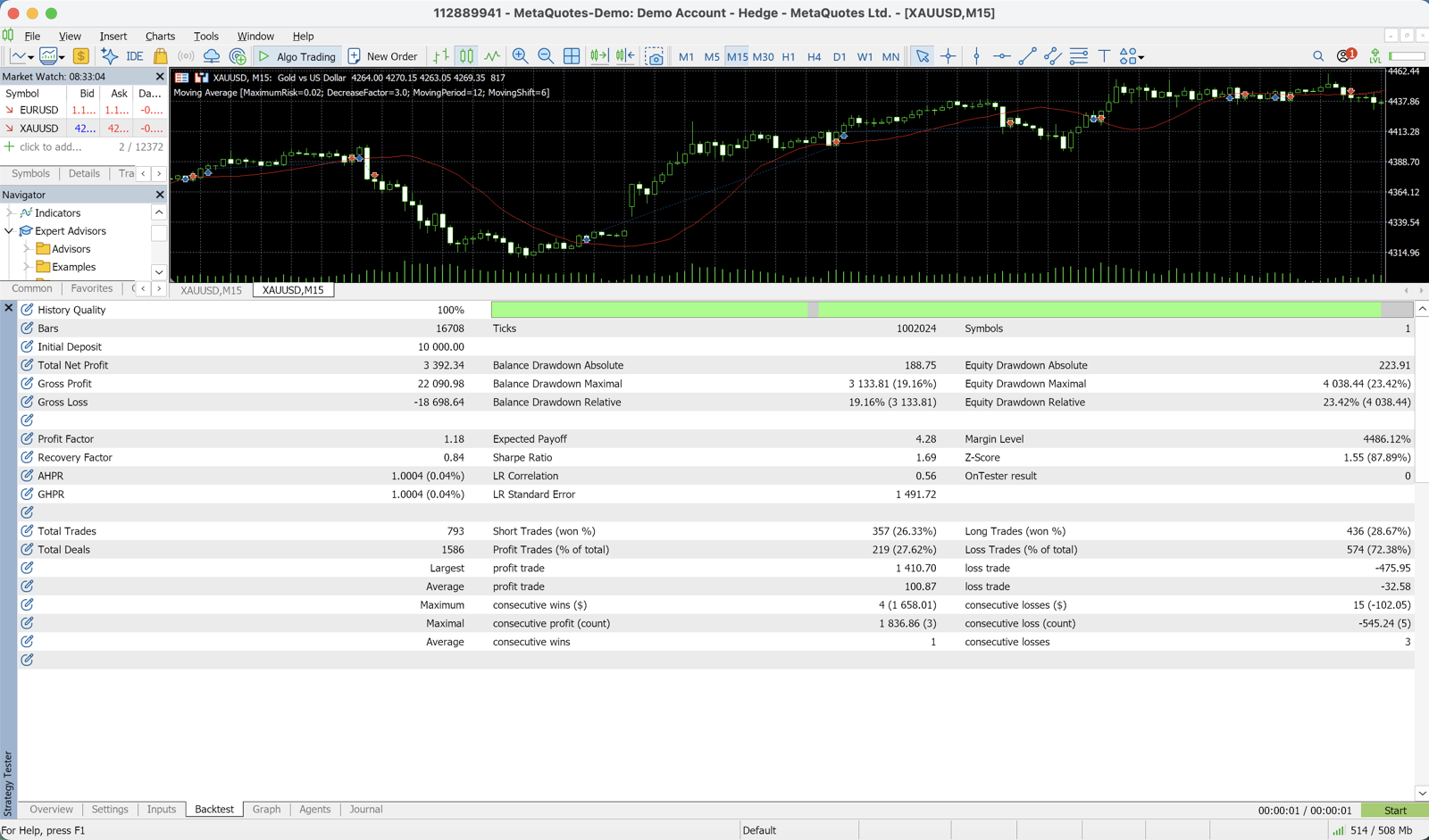
- Note the maximum number of consecutive losses. In the MT5 Strategy Tester, this is the "Maximum consecutive losses (amount/count)" field. Look at both the count and the amount.
- Compare it with the win rate. With a win rate in the 30% range, double-digit losing streaks are to be expected. If an EA has a high win rate but long losing streaks, its losing trades may be concentrated in specific market phases.
- Estimate the "duration of a losing streak" as average holding time × maximum consecutive losses. Check whether this exceeds the slump period you can tolerate.
- Calculate risk per trade × (maximum consecutive losses × 1.3-1.5). If the resulting number is more than you can bear, the only option is to lower the lot size. Changing EAs won't eliminate losing streaks.
- Check both balance DD and equity DD. Floating losses during a losing streak show up on the equity DD side. The difference between MEGAMAX DONCHIAN's balance DD of 15.19% and equity DD of 58.6% is exactly that gap.
- Combine EAs with low correlation. If you line up EAs on the same currency pair with the same logic, their losing streaks will come at the same time. You can compare detailed measurements in the measured ranking of all EAs.
Limits of This Approach
There are three points I want to state honestly.
Maximum consecutive losses is a "single-point" piece of information. Whether there was one streak of 11 losses, or five streaks of 9-11 losses, makes a world of difference to how hard live trading feels. A single line in the report can't distinguish between them. To see the distribution of losing streaks, you need to go through the trade history itself.
The maximum consecutive losses of an EA with few trades is less reliable. BITCOIN GLACIER's maximum of 3 consecutive losses is based on 28 trades. It should be read not as "unlikely to have losing streaks" but as "hasn't yet traded enough times to experience a losing streak."
There are types of losing streaks that don't appear in the backtest. If a range or volatility environment arrives that never occurred during the test period, the record will be broken. We ourselves don't know how far the maximum losing streaks of our own EAs will extend in the future. Precisely because we don't know, we make generous assumptions.
Summary
- Look at maximum consecutive losses before PF or annual return. EA operation fails less from account failure than from "manual shutdown during a losing streak"
- The maximum losing streak in a backtest is not a ceiling but a track record. Extend it by 1.3-1.5x when building your capital plan
- Even a high win rate has losing streaks (GOLD KING v6 has a win rate of 83.1% and a maximum of 10 consecutive losses)
- Double-digit losing streaks in low-win-rate trend following are a feature (MEGAMAX DONCHIAN has a win rate of 35.0% and a maximum of 11 consecutive losses)
- Look not only at "the number of consecutive losses" but at the duration of the losing streak, multiplied by average holding time. Can you endure a slump lasting weeks to months?
- A small maximum losing streak in an EA with few trades may indicate a lack of data rather than strength
- If you get a number you can't endure, lower the lot size rather than changing EAs
The maximum consecutive losses, balance DD, and equity DD of every EA are all listed on the individual pages in the EA list. Before fine-tuning your settings, together with How to set up an EA, decide first how many consecutive losses you can endure for your own account size.
Related
📧 MQL5 Market price-rise alerts + free 5-day email course
Our EAs are free on this site with a live account at a partner broker. The versions sold on the MQL5 Market are at launch pricing and step up as copies sell. Get notified before each rise, plus a daily email on algo-trading essentials, reading backtests correctly, and choosing a broker.
* Privacy strictly protected. You can unsubscribe at any time.
Have a question about EAs or FX?
You can post it on the Nattzy trading forum (free sign-up). Questions beyond this article are welcome too — EA settings, choosing a broker and more.
Ask on Nattzy ↗