
Equity Drawdown vs Balance Drawdown
Contents
Equity Drawdown vs Balance Drawdown
If an EA's sales page says "maximum drawdown 3.2%," you would think it is safe. But if that number is balance-based, the drawdown the account actually endured may have been 14% — roughly four times what is shown.
This is not a typo or a scam. MT5 reports two kinds of drawdown, and which one you read changes the number several-fold.
The two drawdowns
The MT5 Strategy Tester reports drawdown two ways:
| Type | What it measures |
|---|---|
| Balance drawdown | Looks only at the balance when a trade is closed |
| Equity drawdown | Looks at equity in real time, including floating (open) losses |
The decisive difference: balance DD only moves when you close a position. While an EA holds a losing trade open, balance DD sits calm. Equity DD, on the other hand, reflects that floating loss in real time.
Why they differ several-fold
Concrete example. An EA is holding a position with a -1,400 USD floating loss, but has not closed it.
- Balance DD: nothing has happened. The trade isn't closed, so the balance hasn't dropped. The number looks clean.
- Equity DD: the -1,400 USD floating loss flows straight into equity. The number worsens.
And if that position is eventually closed for a small profit, balance DD never records the -1,400 USD episode at all. The account really did endure a -1,400 USD floating loss, yet the balance-based report makes it look as if that moment never existed.
The more an EA holds losers — averaging, grid, martingale — the more these two DDs diverge. An EA that closes wins small and holds losses open can have a beautiful balance DD and a terrifying equity DD at the same time.
So read the equity DD
- If a sales page's DD is balance-based, assume the equity DD is worse.
- If the type isn't stated, ask for the equity DD. If they can't or won't give it, that is itself a warning.
- For averaging and grid EAs especially, assume balance DD badly understates reality.
We made this mistake ourselves once: a Bitcoin EA's headline DD was published as "3.23% balance-based." Its actual equity DD was about 14% — more than a four-fold gap. Since catching that, we standardized every product's DD to equity-based, and note the gap honestly where it is large.
Why hard-stop EAs show matching DDs
By contrast, for an EA that has a hard stop on every trade and does not average down, balance DD and equity DD are nearly identical. The floating loss never runs past the stop, so the balance at close and the equity while open never diverge much.
Our trend EAs, for example, show an equity DD of 10.8% on USDJPY. Because they are hard stop, no grid, that 10.8% is essentially the same as the balance DD — and the same number either way is the proof that no floating loss is being hidden.
Check it yourself
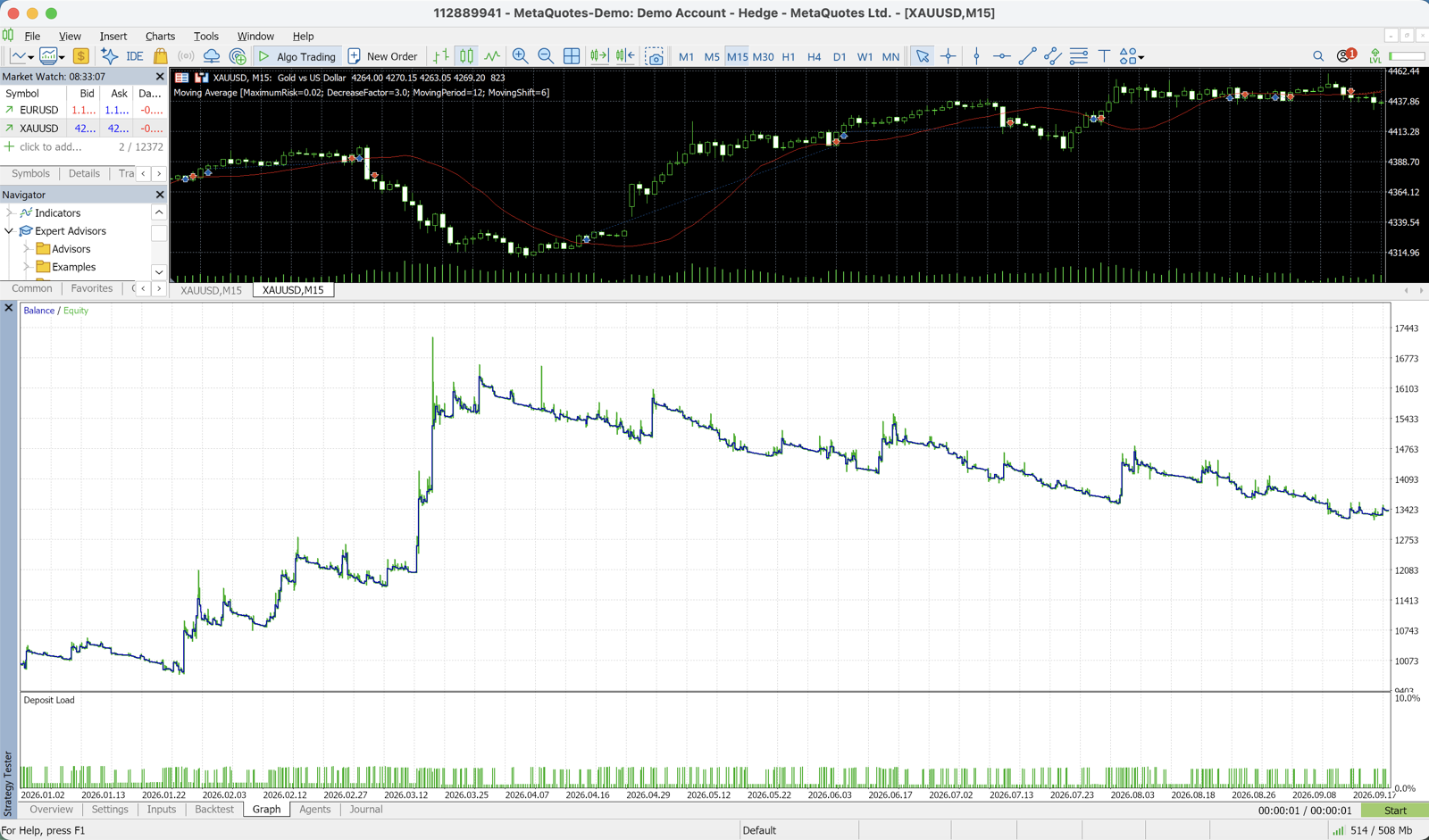
Run a backtest with the free EA (a closed-bar Donchian breakout) and compare the report's "balance drawdown" and "equity drawdown" side by side. For a hard-stop system they should be close — which is what an EA that hides no floating loss looks like.
Donchian Trend Engine (free EA)
The equity-based real data for every product is on the verification page.
Summary
- MT5 reports two drawdowns: balance-based and equity-based.
- For an EA that holds losers, balance DD can look like a fraction of reality.
- The one to read is the equity drawdown.
- An EA that doesn't state, or can't give, the DD type is a warning.
- Hard stop, no grid means the two DDs nearly match.
Related: MT5 EA drawdown management · How to read an MT5 backtest report · Why you can't trust a backtest with few trades
Related
📧 MQL5 Market price-rise alerts + free 5-day email course
Our EAs are free on this site with a live account at a partner broker. The versions sold on the MQL5 Market are at launch pricing and step up as copies sell. Get notified before each rise, plus a daily email on algo-trading essentials, reading backtests correctly, and choosing a broker.
* Privacy strictly protected. You can unsubscribe at any time.
Have a question about EAs or FX?
You can post it on the Nattzy trading forum (free sign-up). Questions beyond this article are welcome too — EA settings, choosing a broker and more.
Ask on Nattzy ↗