
Real Ticks vs 1-Minute OHLC
Contents
Real Ticks vs 1-Minute OHLC: Why the Same EA Gives Opposite Results
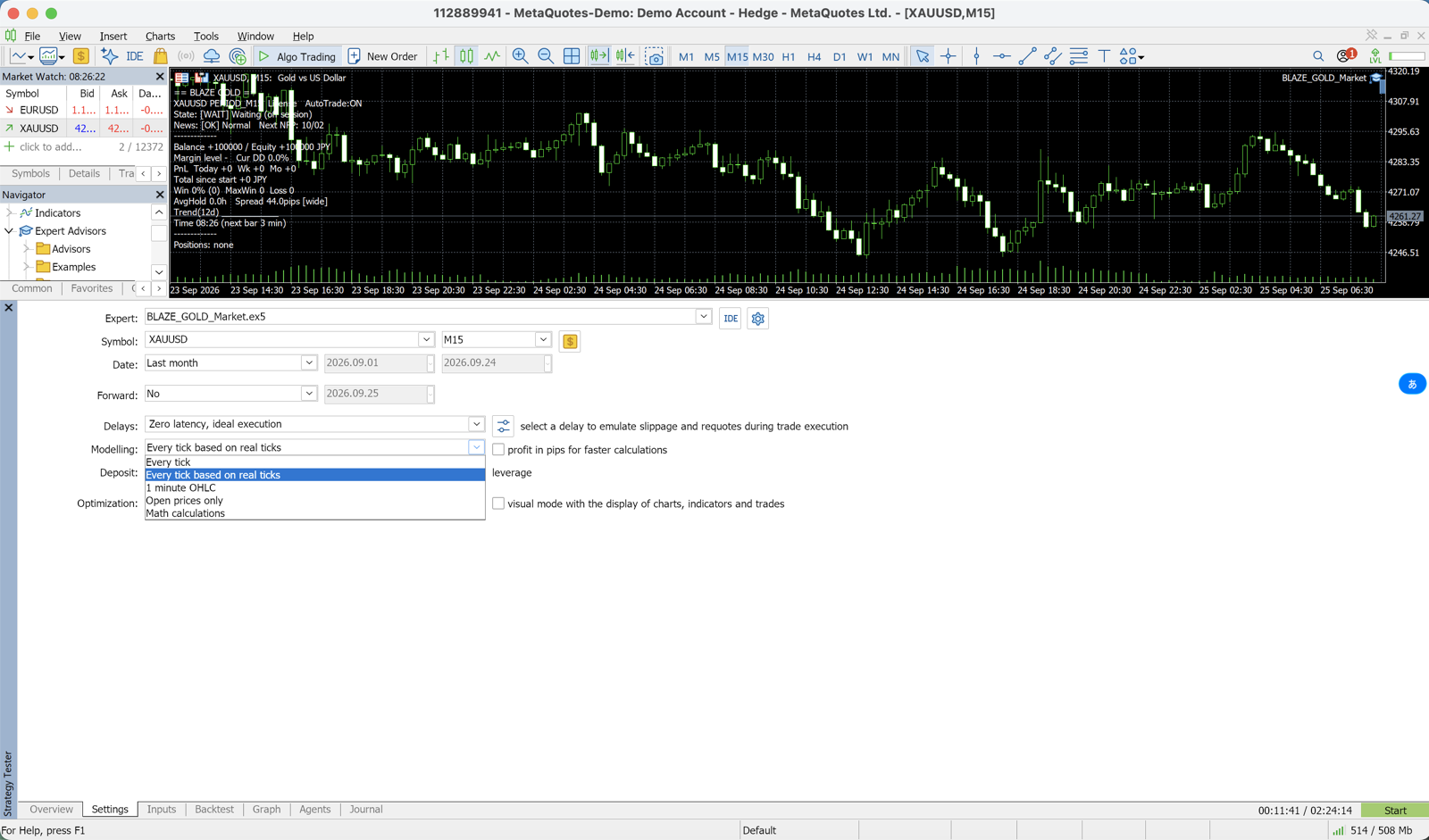
The MT5 Strategy Tester lets you choose a modelling method for the backtest: "Every tick based on real ticks" or "1 minute OHLC." Most people run it without a second thought and trust the number that comes out.
But that single choice can make the same EA — same period, same symbol — produce a result that is not merely different, but the opposite sign. Almost nobody says what it costs you to ignore this, so here are three cases I measured, and the rule for predicting which EAs the model will decide for you.
Case 1: A thin-take-profit grid scalper — modeled ticks lie, badly
A gold grid scalper with a take-profit of about 1.5 USD per position.
| Model | Profit factor | Outcome |
|---|---|---|
| 1-minute OHLC | 2.46 | Looks excellent |
| Every tick (real ticks) | 0.488 | Account down ~65% |
Same code, same period. What convinced me this was an artefact rather than noise is that the number of trades was nearly identical in both runs. The model was not finding different opportunities — it was filling the same ones at prices that never existed inside those minutes.
When the take-profit is thinner than the intrabar path, OHLC interpolation hands you fills for free. For anything thin-TP, grid or scalping, real ticks are mandatory and an OHLC result is worthless.
Case 2: A breakout EA with an ATR stop — modeled ticks lie the other way
This surprises people, so state it plainly: the bias is not always optimistic.
A gold breakout EA with an ATR stop-loss and an ATR take-profit.
| Model | Outcome |
|---|---|
| 1-minute OHLC | Total blow-up |
| Every tick (real ticks, two brokers' histories) | Profitable, profit factor ~1.3 |
The OHLC model has to guess the order in which the high and the low of the minute were touched. When the stop and the target both sit inside the same minute's range, that guess decides the trade. Guess wrong often enough and a viable system looks dead.
Case 3: A bar-close trend follower — the two models agree
Entry only on the close of a completed bar, a hard stop several ATR away, an ATR trailing stop, no fixed take-profit, one position at a time. This type gives essentially the same result under both models.
USDJPY H1, real ticks, January 2017 to May 2026:
- Profit factor 1.50
- Maximum equity drawdown 10.8%
- 631 trades
- Win rate 34.5%
Nothing in that logic depends on where price travelled inside a bar, so there is nothing for the model to get wrong. That closeness is itself evidence of robustness.
The rule of thumb
The tighter the exit relative to the intrabar range, the more the tick model — not the market — decides your backtest.
- Thin take-profit, grid, scalping (anything that can open and close inside one minute): real ticks are mandatory; an OHLC result is worthless.
- Bar-close entries with wide ATR-based stops: the model barely matters. You can honestly sweep on OHLC and confirm the winner on real ticks — which saves an enormous amount of time.
- Stop and target both inside the same 1-minute bar: distrust both models and inspect the fills by hand.
Two practical consequences
-
A backtest that does not state its modelling method is not a result — it is a picture. And the omission correlates with which model was chosen: the more convenient the model, the less likely the report names it.
-
A system whose result collapses when you switch the model was never a system. The model was the edge.
Reproduce it yourself
The EA from Case 3 (a closed-bar Donchian breakout) is free (live-account registration). Run it once in the Strategy Tester with "Every tick based on real ticks" and once with "1 minute OHLC," and compare. A bar-close system should give you nearly the same result both times — that is what a healthy EA looks like.
Donchian Trend Engine (free EA)
If you want the same closed-bar, hard-stop, trailing-stop discipline as a real-tick-verified product, see MEGAMAX DONCHIAN (USDJPY), BITCOIN COMET (BTCUSD) or ATLAS (5-market portfolio) — every trade has a stop-loss, no grid, no martingale (MEGAMAX DONCHIAN places it on the broker's server; COMET and ATLAS's crypto legs are monitored and closed by the EA itself), with full real-data verification published.
Summary
- The model choice alone can flip an EA's result from good to hopeless.
- Thin-TP, grid and scalping need real ticks (OHLC invents fills that never happened).
- A bar-close trend follower agrees under both models — which is itself evidence of robustness.
- Never trust a backtest that does not state its model.
Related: Scalping Robot Pro Test: 82.9% to 12.6% Win Rate by Feed · We backtested 43 popular gold EAs on 11.5 years of real data · How to spot curve fitting · MT5 backtest tick quality · 312 MQL5 EAs Tested: Real Ticks Cut Median PF from 2.46 to 0.92
Related
📧 MQL5 Market price-rise alerts + free 5-day email course
Our EAs are free on this site with a live account at a partner broker. The versions sold on the MQL5 Market are at launch pricing and step up as copies sell. Get notified before each rise, plus a daily email on algo-trading essentials, reading backtests correctly, and choosing a broker.
* Privacy strictly protected. You can unsubscribe at any time.
Have a question about EAs or FX?
You can post it on the Nattzy trading forum (free sign-up). Questions beyond this article are welcome too — EA settings, choosing a broker and more.
Ask on Nattzy ↗