
Handling Drawdown — Surviving Losing Streaks and Staying in
Last updated: 2026-05-20 | Estimated reading time: 12 min
No matter how good an EA is, drawdowns — temporary declines in account equity — are unavoidable. Many traders who fail with EAs don't have a flawed strategy; they simply can't endure the drawdown and shut the EA down at the worst possible moment. This article explains how to deal with drawdowns in a rational, disciplined way.
Table of Contents
What Is Drawdown?
Drawdown (DD) is the decline in account balance from a recent peak. For example, if your balance drops from ¥100,000 to ¥80,000, your drawdown is 20%.
Drawdown is not a sign that an EA is broken — it is an unavoidable cost of generating profits in the market. Even a positive-edge EA doesn't produce wins and losses in a tidy alternating sequence; there will always be periods where losses cluster into a streak. What matters is whether you can experience that period as something "within expectations."
Recovery Requires More Gain Than the Loss Itself
One thing people often overlook about drawdown is that the percentage lost and the percentage needed to recover are not equal. To restore an account that has dropped 20%, you don't need 20% — you need 25%.
The deeper the drawdown, the more sharply this gap widens. That's why a severe drawdown can't be brushed off with "it'll come back eventually." Keeping drawdowns shallow in the first place is the most important form of money management.
| Drawdown | Gain needed to recover |
|---|---|
| 10% | ~11% |
| 20% | 25% |
| 30% | ~43% |
| 50% | 100% |
| 70% | ~233% |
What Not to Do During a Losing Streak
Increase lot size to "win it back"
Raising your lot size during a losing streak is the surest way to destroy an account. Increasing risk when losses are already piling up can turn a drawdown into a fatal wound.
Change EA parameters mid-operation
Making changes during a drawdown invalidates all the data from your validation period up to that point. If you want to make changes, stop the EA first and redo the backtesting and forward testing from scratch.
Stop the EA at the worst possible moment
If you stop the EA at the bottom of a drawdown, you'll miss the subsequent recovery. Only stop based on pre-defined rules — not emotion.
Constantly switching to another "promising EA"
If you switch EAs every time one draws down, you end up experiencing only the worst period of each EA in sequence. Once you've validated and adopted an EA, stick with it for the predetermined period.
How to Distinguish a Normal DD from an Abnormal One
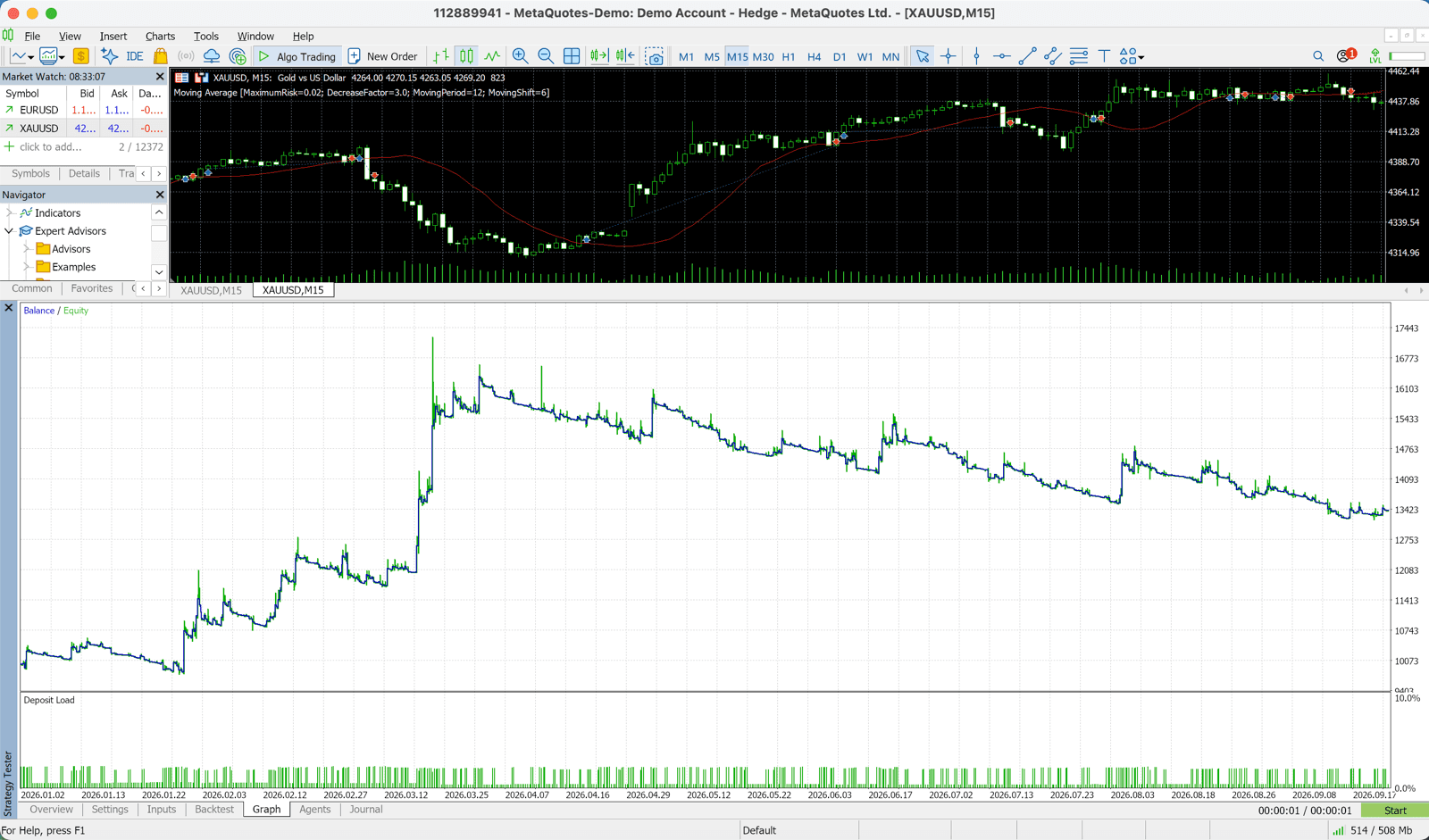
Not every drawdown calls for alarm. The key question is whether it is "within expectations" or "beyond expectations."
If the drawdown is within the range of the maximum DD seen in your backtest or forward test, it is a normal fluctuation. On the other hand, if it significantly exceeds the historical maximum, or if the trade behavior is clearly different from the backtest, you should suspect a change in market conditions or an EA malfunction.
| Condition | Assessment |
|---|---|
| DD within BT max | Normal. Continue — this is an expected fluctuation. |
| DD is 1.0–1.5× BT max | Watch closely. Keep records and continue with caution. |
| DD exceeds 1.5× BT max | Investigate. Switch to demo and find the cause. |
| Trade behavior clearly differs from BT | Abnormal. Stop the EA and check for malfunctions. |
How to Set a Stop-Trading Line
To avoid making emotional decisions during a drawdown, set a specific numeric threshold before you start operating — "if it drops this far, I stop" — and write it down. Having this rule in place means no second-guessing when the moment comes.
A common guideline is to set the stop line at roughly 1.5× the maximum drawdown from your backtest. Many EAs include parameters like MaxMonthlyDD (automatic stop when monthly DD % exceeds a threshold) that can automate this for you.
Set the stop line as a specific number
Decide before you start: "Stop if relative DD reaches X%." Write it down and commit to it.
Configure automatic stop parameters
Enable EA-side safety features such as DailyLossLimitPct and MaxMonthlyDD.
Investigate before resuming after a stop
After stopping, don't restart on emotion. Confirm the cause through walk-forward or forward testing before making any decision.
💰 Money Management to Keep Drawdowns Shallow
Money management is your best weapon against deep drawdowns. Review the basics of risk % and lot calculation.
Read Risk & Money Management →