
Moving from Demo to Live — Before You Run Your EA on Real
Last updated: 2026-05-20 | Estimated reading time: 12 min
Taking an EA that has passed backtesting and demo verification and running it on real money is the most critical transition in EA operation. Rushing to a live account means entrusting capital to an EA that has not been adequately validated. This article explains how to time the move and proceed safely. Note: our free EAs do not run on demo accounts. Check them in the Strategy Tester, then start on your registered live account with the minimum lot (versions bought on the MQL5 Market do run on demo accounts).
Contents
Why you should not skip straight to a live account
A strong backtest result is simply a curve-fit to historical data. Whether an EA will work on live, real-time markets can only be confirmed by running it in real time. A demo account is the safe place to do that.
On a demo account you can run your EA against real market prices without risking a single dollar — letting you assess its behavior, execution quality, and any operational issues with no financial exposure. Skipping this stage is equivalent to handing capital to an EA you have never actually tested in live market conditions.
What to verify on a demo account
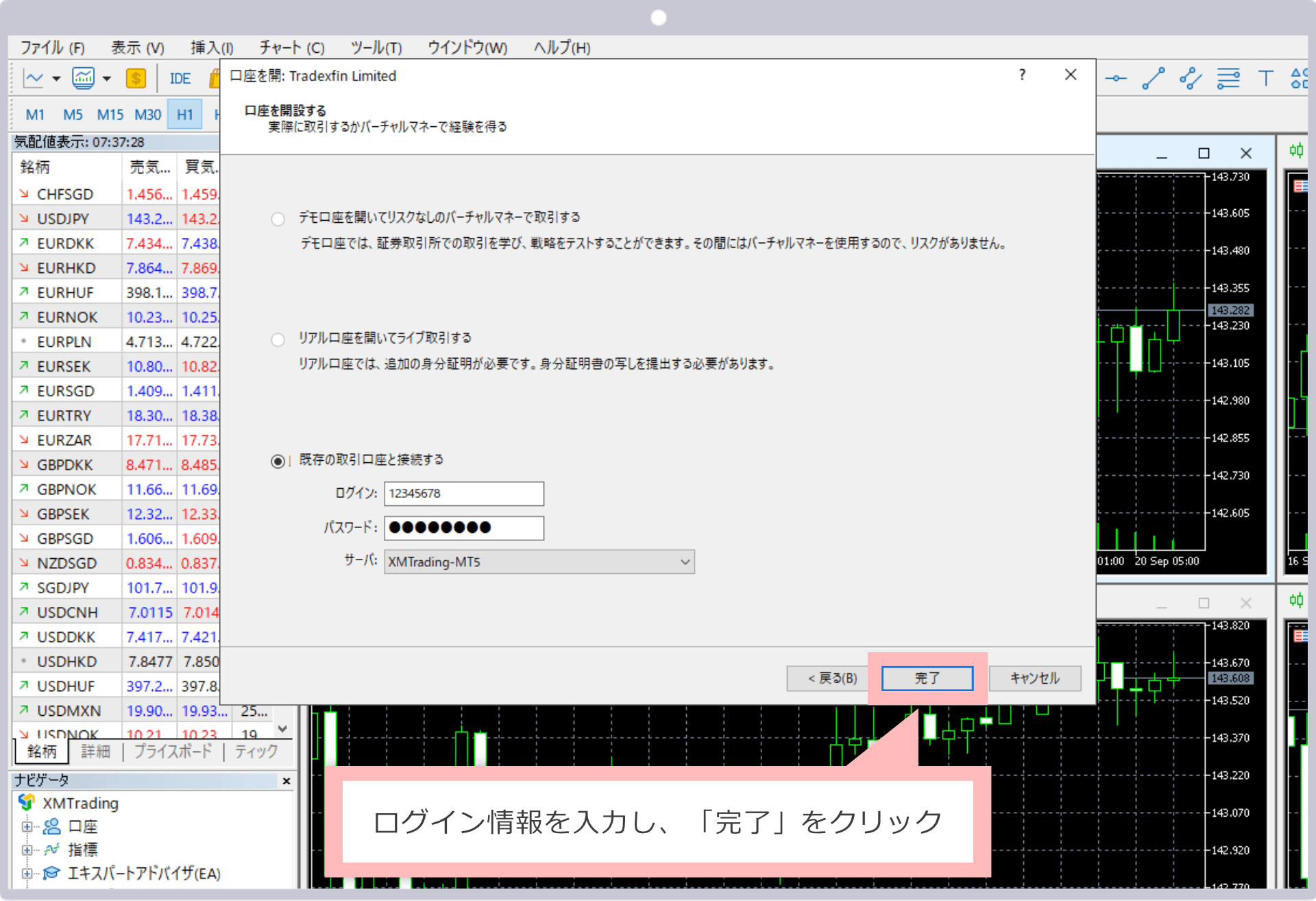
During demo operation, check the following points — not just overall performance.
How closely results match the backtest
Check whether demo PF falls within 70–130% of the backtest figure. A large downside deviation may indicate over-optimization or an unrealistic spread setting in the backtest.
Errors and unexpected behavior
Watch for order errors or unexpected EA behavior. Check the Expert / Journal logs regularly.
Whether the EA is trading as expected
Confirm that entry and exit timing, lot sizes, and SL/TP levels match the backtest behavior.
Drawdown depth
Check that the maximum drawdown during the demo period stays within the range seen in the backtest, and that you can tolerate it psychologically.
Criteria for switching to a live account
Consider moving to a live account only when all of the following conditions are met.
| Criterion | Standard |
|---|---|
| Demo run duration | At least 3 months (6 months or more for low-frequency EAs) |
| Number of trades | At least 50 trades, ideally 100 or more |
| Deviation from BT | Demo PF is at least 70% of the backtest PF |
| Drawdown | Demo max DD is within 1.5× the backtest max DD |
| Issues | No unresolved errors or unexpected behavior |
Sizing your initial lot and starting capital
Even when you decide to go live, do not start with a large capital base or large lot size. There will always be a gap between demo and live performance, and you should measure that gap at small scale first.
Start at the minimum lot size (0.01 on XM Standard) or reduce your risk percentage to roughly half the level you used on demo. Run the live account for one to two months to confirm it behaves the same as demo before gradually scaling up capital and lot size.
Differences between demo and live accounts
Even a strong demo track record may look slightly different on a live account due to the following factors.
Execution speed and slippage
Live fills are typically slightly slower than demo and slippage tends to be larger. Scalping EAs are the most affected.
Spread differences
Some brokers show different spreads on demo versus live accounts. The live spread is often wider.
Order rejections and requotes
Orders being rejected or repriced are more common on a live account than on demo.
Psychological impact
Real money makes it harder to stay rational during a drawdown. The real test is whether you can stick to your rules when it counts.
📡 Review what forward testing actually means
Demo operation is forward testing. Revisit how to read the results and set pass/fail criteria.
Read the forward testing guide →