
Backtest Pitfalls — What Only Live Testing Can Reveal
Last updated: 2026-05-20 | Estimated reading time: 15 min
A backtest that shows a steadily rising equity curve does not guarantee future profits. Backtests contain several structural pitfalls that make results look better than reality. This article explains what those pitfalls are and how live forward testing provides the reality check that backtesting cannot.
Contents
Why "Too Good" Backtest Results Are a Red Flag
A backtest is a simulation run against historical price data. Because history offers only one fixed path, there is always the temptation — and the technical ability — to fit a strategy to it until the numbers look great. This is over-optimization, also known as curve-fitting.
On top of that, if the backtest settings are more favorable than real-world conditions — fixed narrow spreads, instant fills at the requested price — the results will appear better than what live trading would actually produce. These gaps between simulation assumptions and reality compound into a significant divergence.
Modeling Quality and Tick Data
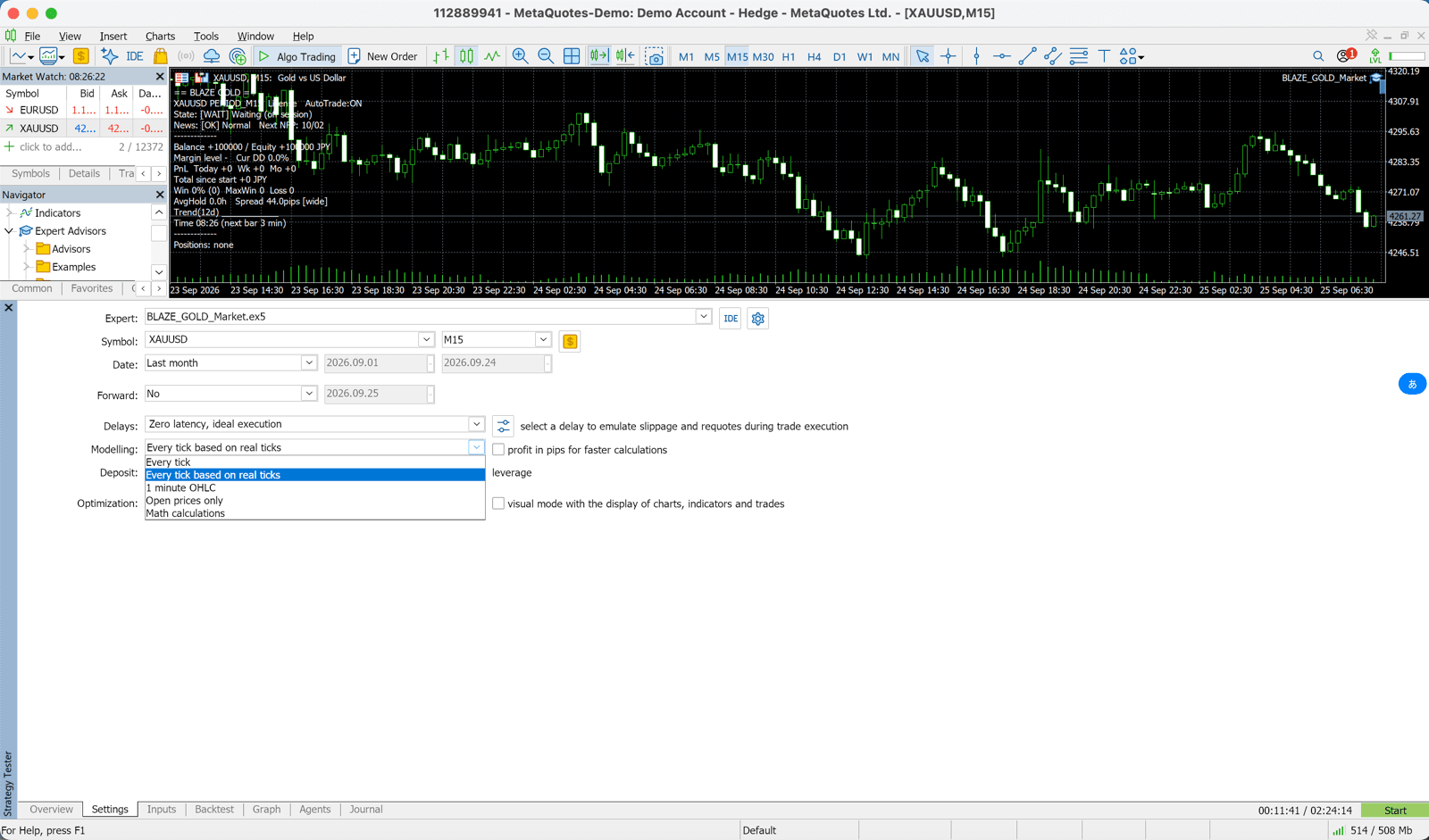
The MT5 Strategy Tester calculates results at different levels of precision depending on the modeling mode you select. With lower-quality open-price-only mode, price movement within a single bar is ignored, and whether the price touched your SL or TP is not determined accurately.
The most accurate options are "Every Tick (the most accurate method based on the smallest available time frames)" and "Every Real Tick." The former typically reports ~99.9% modeling quality. Strategies with tight price targets — scalping in particular — are most sensitive to tick-level accuracy.
| Modeling Mode | Quality | Appropriate Use |
|---|---|---|
| Open prices only | Low | Rough directional check only |
| 1-minute OHLC | Moderate | Quick preliminary check |
| Every Tick | ~99.9% | Required for any serious pre-release validation |
| Every Real Tick | Highest | Precision validation using actual broker tick data |
Four Commonly Overlooked Costs
These factors appear small in backtesting but can meaningfully erode profits in live trading.
Spread Variation
Backtests commonly use a fixed spread, but real spreads fluctuate with market conditions and can widen to 5–10 times their typical value around major economic data releases. Using a spread that is too narrow systematically understates your actual trading costs.
Slippage
Slippage is the difference between the price you requested and the price you actually received. It is largely ignored in backtesting, but during fast market moves or scalping, it can become a material drag on performance.
Swap (Overnight Financing)
Swap is the interest cost charged when a position is held overnight. For long-holding EAs, accumulated swap can significantly affect the bottom line. Verify that the swap rates in your backtest match the rates your broker actually charges.
Order Rejections and Requotes
In live trading, orders can be rejected outright or requoted at a different price. Backtests assume every order fills — this friction is never replicated in simulation.
Backtest Pitfall Checklist
When reviewing backtest results, check each of the following items. The more that apply, the more you should discount the numbers.
| Check | The Pitfall |
|---|---|
| Modeling quality below 99.9% | Intra-bar price movement is ignored; SL/TP triggers are inaccurate |
| Fixed narrow spread | Actual transaction costs are systematically understated |
| Short test period (under 3 years) | Results reflect only specific market conditions and may be skewed |
| PF above 3.0 or an unnaturally smooth equity curve | Strong indication of over-optimization |
| Evaluated on the same period used for optimization | Curve-fitting is being mistaken for genuine skill |
| Single currency pair, single time period | Results may be a lucky coincidence rather than a repeatable edge |
Validating with Multiple Periods and Live Testing
The best way to sidestep backtest pitfalls is to validate across multiple independent conditions. A single strong result may be coincidence; consistent profitability across different periods and conditions is a much more reliable signal of genuine edge.
Test Across Multiple Sub-Periods
Divide 10 years of data into three or four distinct sub-periods and check whether each one is independently profitable. If a single outstanding period is carrying the overall result, that warrants caution.
Use Walk-Forward Analysis to Detect Over-Optimization
Confirm that performance does not collapse during the out-of-sample (OOS) period — data that was never used in optimization. This is the most reliable method for detecting curve-fitting.
Expose the EA to Live Markets via Forward Testing
Run the EA on a demo account for at least three months and check whether it achieves 70–130% of its backtest performance under real spreads and slippage. Note: our free EAs do not run on demo accounts. Check them in the Strategy Tester, then start on your registered live account with the minimum lot (versions bought on the MQL5 Market do run on demo accounts).
🔬 Detect Over-Optimization with Walk-Forward Analysis
Over-optimization is the most insidious of the backtest pitfalls. The walk-forward analysis article walks through the exact steps for detecting it.
Read: Walk-Forward Analysis →